



Watch the Video Guide
What should you actually be comparing?
Most wood flooring searches start online, and within about ten minutes you’re looking at hundreds of options, a pile of technical terms and prices that swing wildly between boards that look more or less identical in a photograph. It’s hard to know what you’re looking at, let alone what you ought to be looking for.
In this article I will cover five key factors you should consider when purchasing engineered wood flooring: dimensions, wear layer, structure, finish and grade. Get those straight and hundreds of options become a shortlist fairly quickly.
Here’s what each one means and how much weight it deserves.
A word on taste before we start
I’ve been in the family business since 2011 and in that time I’ve met customers with completely opposite ideas of what looks best. What one person falls for, the next will immediately dismiss, and neither of them is wrong.
So width, length and grade are mostly a matter of taste, and on those I’ll give you pointers rather than rules. Thickness, wear layer, structure and finish are practical decisions where the right call matters, and those I’ll go into in more detail.
Dimensions
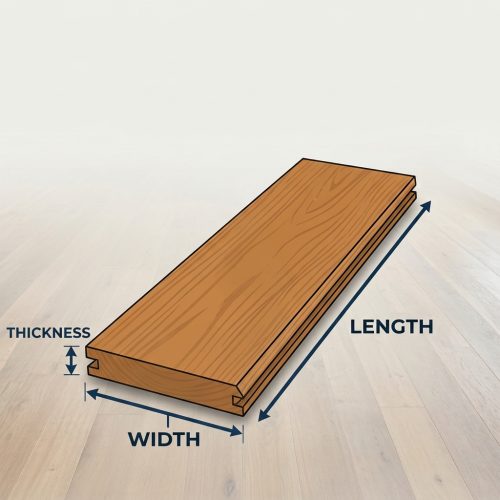
Dimensions cover three things: the width of the board, its length, and its overall thickness. The first two you’ll see every day. The third you’ll never see again once it’s down, but it can have some major practical implications.
Longer and wider boards have been popular for years now. They give a floor a more free-flowing look and are quicker to install. They also cost more, so they need to be in the budget from the start. Random length boards, where each pack holds a mixture of lengths, are cheaper because the manufacturer can get better yield from the timber, and plenty of people prefer the more traditional look they offer.
The honest advice on length and width is to look at genuine photographs of finished floors, even random ones in magazines or on social media, and notice which width and length profile keeps appealing to you. This is not something you can easily judge from small samples. Decide on the profile first, then request samples of boards you already know are the dimensions that suit your preferences.
Thickness is a practical decision rather than a visual one, and it’s worth checking early. Your subfloor, your existing floor heights, your internal door clearances and your underfloor heating can each set a maximum or a minimum, and if you’re spanning battens or joists you’ll need longer, thicker boards. Underfloor heating in particular can cap the thickness of floor you’re allowed, so if you have it, or you’re having it, read our guide on choosing a wood floor for underfloor heating before you shortlist anything. Sorting this out at the start can rule out half the market in five minutes and save you weeks.
Wear Layer
The wear layer is the solid hardwood on the top surface of an engineered board. It’s called that because it’s the layer you sand, and wear back over the years. The thicker the wear layer, the more times the floor can be sanded and brought back to life over its lifetime.
Wear layer and board thickness go hand in hand. Thicker boards generally carry thicker wear layers, thinner boards thinner ones. A 6mm wear layer on a 21mm board can give you as many sandings as a solid wood floor would.
We have a separate video and article that covers wear layers in more detail that can be found here: Wear Layer – All You Need To Know
Structure
Structure is what the board is made of underneath the bit you look at. It’s the most overlooked of the five and, in my view, one of the most important.
The two common types of construction found in the engineered wood flooring market are 3-ply and multi-laminate plywood (often shortened to multi-ply). A 3-ply board has three layers in total: the hardwood wear layer, a middle layer and a backing layer. Despite the name, it isn’t a true plywood core, and with only three layers working against each other it doesn’t offer the stability a multi-ply does.
A multi-laminate plywood core is built from many thin layers bonded with their grain running in opposite directions. That cross-layered construction is what keeps the board stable and significantly reduces expansion and contraction within the floor. If your floor is going over underfloor heating, in a large space, or into a room with higher fluctuation of temperature / humidity, this is the factor that can decide whether your floor stays stable or excessively moves.
Structure also changes how a floor feels underfoot. A dense multi-ply core feels solid and substantial to walk on, where a lighter weight board can sound and feel less solid underfoot. Get samples of both structures and you’ll notice it immediately, just by the weight in your hand. Our article on engineered wood flooring construction goes through this in greater detail.
Finish
The finish is the protective treatment on the surface of the wood, either applied at the factory or applied on site after the floor is laid. It sets the colour and the sheen, and because the finish plays such a large role in determining the look of the floor, it’s common for people to concentrate on looks alone. However, the finish will also determine how the floor copes with spills, its durability, how easy it is to clean, and how simply it can be repaired.
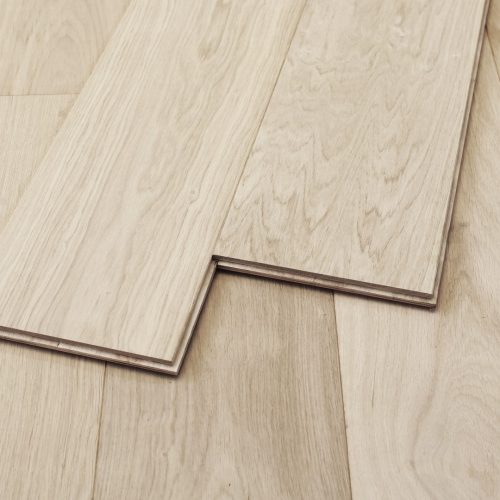
A finish that’s perfect in a quiet bedroom can be the wrong call in a family kitchen or a hallway. The main options are lacquered, UV-oiled, natural oiled, hardwax oiled, and unfinished boards treated on site, and each have their own set of pros and cons. Unfinished in particular is worth a proper look, because it has numerous advantages that are not necessarily obvious.
We’ve written a full guide to wood flooring finishes, and it’s worth ten minutes if your floor is going anywhere busy or anywhere prone to spills.
Grade
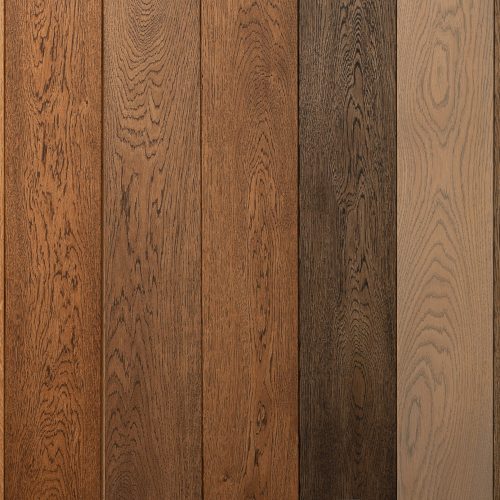
Grade describes the amount of natural characteristics in the timber: knots, colour variation, grain pattern and natural imperfections. It’s largely a visual choice, and it depends on your taste and the style of the property.
At the cleaner end sits Prime, or AB, with few knots and a consistent, minimalist look that can suit contemporary interiors. Select comes next, still clean but with a little more colour variation and character. In the middle is Natural, also sold as Classic or ABCD, which has more knots and movement without looking rustic. It’s the happy medium and, in our experience, the most popular choice across the widest range of homes. At the other end, Character and Rustic celebrate the timber’s imperfections, with larger knots, splits and plenty of variation.
One thing to be clear about: grade and quality are separate. A superbly built board can intentionally be a very rustic grade, and a low-quality board can be Prime. Grade tells you what the floor looks like. Structure, wear layer and finish tell you how it will perform.
Grading can be a confusing, and sometimes misleading, topic and for this reason we have created a separate video and article which covers this in more detail: Understanding Gradings of Wood Floors
What we do at JFJ
We’re a family business with over a hundred years in the timber industry behind us, and we don’t fit floors, which means we’ve no reason to talk you into something that suits us rather than you. If you’d rather talk it through than read about it, that’s usually the quickest route to an answer.
Take the free samples as well. Handle them, compare the weight of a multi-ply against a lighter board, look at the finish in your own light next to your own doors and furniture. And if samples still aren’t enough to settle the grade question, ask us about a trial box.
Common questions
What’s the most important factor when buying engineered wood flooring?
Two really: finish and structure. Finish because of what a large role it plays in both looks and practicality. A suitable finish will be immediately beneficial from day 1. And structure because this is what creates a stable, reliable and solid feeling floor underfoot.
Does a thicker board mean a better floor?
Not on its own. Thickness usually brings a thicker wear layer with it, which does mean more sandings over the floor’s life, but a thick board with a poor core is still a poor board. Thickness is also constrained by your site rather than chosen freely, since subfloor height, door clearances and underfloor heating can all cap it. Work out what thickness you’re allowed first, then buy the best-built board inside that limit.
Can you tell the grade of a floor from a sample?
No, and this is one of the most common causes of disappointment. Samples are too small to represent grade. Even a heavily rustic floor will contain sections with no knots or character, so a sample can easily show you the least representative part of the floor. Genuine photographs are far more reliable, and a trial box is better still.
Is prime grade better quality than rustic?
No. They’re different looks, not different standards. Prime has fewer knots and a more uniform appearance, rustic has more character, and both can be built well or badly. Quality lives in the core, the wear layer and the finish. Grade is purely about the face of the timber, so choose it based on what suits your tastes and property.
More on choosing the look of your floor
Now that you have read our top 5 tips for wood flooring considerations, read some more guides to help you choose the right finish, the perfect treatment and advice on colours to finish it to perfection.
- Colour – Not the only factor to consider? It’s not all about the colour. There are many aspects to consider when purchasing your wooden floor, and you must make sure that colour isn’t the only thing you think about.
- White and Lime Floorboard Tips; If you are going white, read our guide on why lighter oak finishes work in some homes and not others, a modern choice that works in the right property.
- How to avoid an Orange wooden floor; It’s not uncommon for people to be concerned about not wanting their floor to be orange in colour.